Image
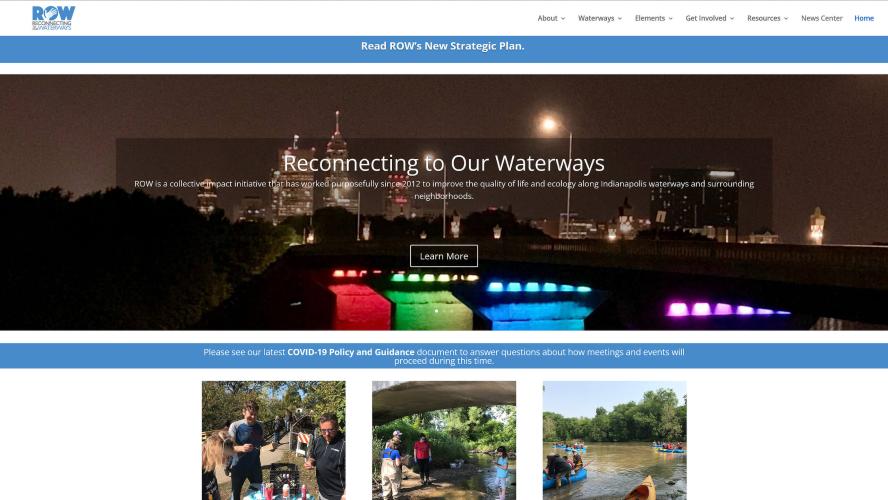

Reconnecting to Our Waterways (ROW) brings together Indianapolis neighborhoods and residents, nonprofit and private organizations, public agencies, and civic leaders around a shared purpose. Rather than having each group work separately, ROW uses a collective impact model to get people moving in the same direction.
So, what exactly does “collective impact” mean?
At its simplest, it means that people and organizations from different parts of a community commit to a common goal and coordinate their efforts to achieve it. The idea is pretty straightforward: when a social problem is large and complicated, no single organization is likely to solve it by itself. Lasting change takes people working together, sharing information, and pulling in the same direction.
ROW is built around that idea.
As a grassroots collective impact initiative, ROW’s partners have agreed on a common agenda and a shared approach to improving Indianapolis’ waterways and the communities connected to them. This goes a step beyond simply saying, “Let’s collaborate.” Collective impact requires a more deliberate structure, with clear expectations for how organizations work together.
Five conditions are especially important.
Everyone involved needs to understand what they are working toward. That means having a common view of the problem, a shared vision for change, and agreement about the actions needed to get there.
You can’t really tell whether something is working if everyone measures success differently. ROW partners collect information and track results in consistent ways, which helps everyone see what’s happening, learn from the results, and hold one another accountable.
Each participant brings something different to the table. The goal isn’t for everyone to do the exact same thing. Instead, organizations and committees take on distinct roles while coordinating those efforts through a shared plan of action.
This one sounds obvious, but it matters—a lot. With so many people, organizations, and neighborhoods involved, regular and open communication helps build trust, keep people focused on the shared goals, and remind everyone why they got involved in the first place.
Collective impact doesn’t simply happen because a bunch of organizations agree that cooperation is a good idea. Someone has to keep the train on the tracks.
That’s where the backbone organization comes in. A dedicated team provides the staff, coordination, structure, and specialized skills needed to keep the larger initiative moving while supporting the organizations and agencies involved.
ROW’s collective impact depends on everyone contributing in some way.
A Steering Committee, made up of 17 mission-aligned organizations, provides strategic leadership for ROW. The committee also includes six representatives from each Waterway Committee, bringing neighborhood-level perspectives into the larger conversation.
The six Waterway Committees primarily work at the neighborhood level. Residents, local institutions, and community organizations all have a seat at the table, helping shape priorities and activities based on what is happening in their own communities.
Then there are the Element Committees, which bring together organizations with expertise in specific areas related to ROW’s work. These groups contribute knowledge and experience that might not otherwise be available within the neighborhood committees themselves.
And, of course, the partners matter. They provide resources, expertise, connections, and guidance. The marketing committee helps keep ROW visible throughout the year, spreading the word about the initiative and the work happening across Indianapolis.
It’s a lot of moving pieces. That’s intentional.
ROW’s strength comes from bringing those pieces together—residents, organizations, experts, civic leaders, and community partners—so that their individual efforts can add up to something much bigger than any one group could accomplish alone.